Tuesday, October 26, 2010

Feathers


Feathers
By Jacqueline Woodson
5/5 *****
6th grade and up

This book was such a quick read, and involved so many different discussion topics and controversies.  Frannie, the main character, is such a passionate and relatable character, she is sure to draw readers into her story.  Frannie lives in a segregated town, although the story takes place in the 1970s.  A new (white) student comes to her all-black school in 6th grade, and the book is about how he adjusts and how Frannie befriends him and many other issues arise. 

This book could be used to relate or introduce many topics, including but not limited to: segregation, racism, religion (Christianity), bullying, adoption, accepting each other’s differences, poverty, disabilities and many others.   The new student is called Jesus, because he is skinny, white and has long, curly brown hair.  Throughout the story, there are numerous references to Christianity, and I think that is one of the main reasons why this book could be slightly controversial for an elementary classroom.  Another reason, is the blatant racism, references to poverty and bullying/stereotyping situations that occur throughout the story.  Frannie’s older brother is deaf and communicates via sign language; Frannie’s mother has gone through multiple miscarriages/infant deaths.  Both of these introduce new issues that students might ask questions about, and could possibly be controversial or uncomfortable to discuss.
 
However, because the book has such a caring and passionate main character, an emphasis on positive family and friend relationships, and a goal to find hope and faith in life, I think that overall the positive things students can get out of this book are definitely worth discussing the possibly controversial topics the book introduces.  If I had the chance to teach this book to upper elementary students I definitely would, although I would make sure to thoroughly discuss all of the topics and make sure the students all feel comfortable about what the book is saying.

One thing that would definitely be worth discussing in terms of literary devices, besides the themes discussed previously, is the metaphor mentioned in the title.  In the beginning of the book, Frannie reads, “Hope is the thing with feathers” and continues to search for this elusive “hope” throughout the book.  She takes it literally at first, but her brother explains to her that it is a metaphor.  This would be a great example that upper elementary students would likely understand, to introduce metaphors and then move into other a discussion of other related literary devices.  

The Giver

The Giver
By Lois Lowery
5/5 *****
5th-6th graders

I absolutely love The Giver. It has always been one of my all-time favorite books, and it was so interesting to re-read it after reading it in either 5th or 6th grade. I read it just for fun in elementary school, and after reading it now, I see that I did not understand lots it the first time. It is such a great example of science fiction and would be such an interesting book to teach in a classroom; if I ever have the opportunity to teach it, I definitely will despite the controversy it explores.

After reading it this time, I had such a different response to it. I still found it incredibly interesting, but I hadn’t previously realized exactly what being “released” meant, the idea that maybe Jonas dies at the end or the extremely controversial society. While this book would bring up so many controversial topic, such as suicide, pre-determined lives, extreme micro-management by a select group of individuals, lying, death, the power of choice, history etc… it would be so beneficial to young students to be exposed to this alternate way of life. I think it would make students really appreciate having the power to choose their own destinies.

This would be a great book to relate to social studies, I think, because of the different historical societies you could relate it to. I know as a young student, I read about our culture here in the United States (pulling teeth, having surgery, riding bicycles etc…) from an outside perspective and I remember thinking it was so strange- not making the connection that it was a description of my own culture and my way of life. I think that it would really help students see other ways of life and other cultures in a more meaningful way, and in a more accepting way. And building this cultural competency is very important in today’s society. There are just so many different directions you could go with this book, the list of topics that come to mind seems almost endless.

And I have to give my opinion on the ending: I personally think that Jonas and Gabe don’t die, that they eventually find Elsewhere and that it is a fulfilling world full of choice and happiness, that is just the optimist in me. I have read the sequel to the book, and while it has nothing to do with Jonas or any of the original characters, I highly recommend it!

The Man Who Walked Between the Towers


The Man Who Walked Between the Towers
By Mordicai Gerstein
5/5 *****
3rd-5th graders

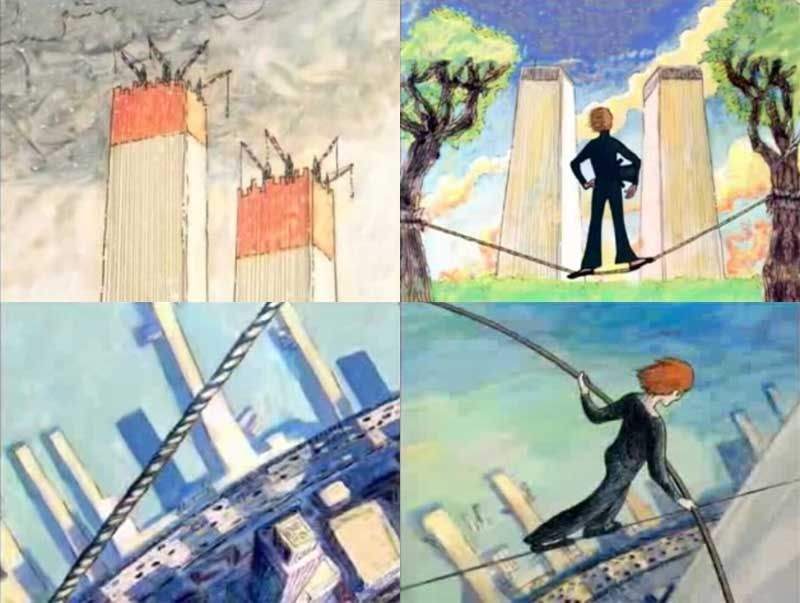
I found this Caldecott Award winning book to be quite unique and interesting. It wasn’t the typical non-fiction story.  The illustrations were outstanding; several of the pages opened up into 3-page long illustrations detailing city skylines and beautiful views of the city. Philippe, the main character in the book, secretly ties a wire between the World Trade Centers, and walks across it mid-day in 1974.  It is based on true events according to the final page of the book.   I think this would be a great book to use in the classroom for several reasons.

The illustrations are fantastic.  They expand on what the writing says, and this is one sign of a high quality picture book.  One main way I would personally use it in the classroom, is to relate to social studies.  This is based on a historical event, although it may not follow the exact details all the way through.  It would be great to have upper elementary students do some research on a little known figure in history, and to think of some way to creatively tell their story to the class.  It would be a fun and interesting way to explore different parts of history, and then to use creativity and writing skills to share their findings with their peers.  Because the police were involved and Philippe was arrested for his actions, this is yet another way to relate the book to history.  There have been many times that people in history have done things knowing they would get arrested, but they did them anyway because they felt passionately about it.  Using this as a light hearted example to lead into Civil Rights era situations (ie Rosa Parks, Ruby Bridges, peaceful sit-ins etc… ) could be a meaningful activity for the students.
The language the author used to write this story is absolutely beautiful.  It is almost poetic sounding, although there is no rhyming involved.  The descriptions of events and people are very detailed, and it really gets the reader intrigued and curious about what is going to happen.

One thing that was a little awkward for me was when the author mentioned, “Now the towers are gone”.  I felt like it either needed to be left out or at least briefly explained.  Because 9/11 is such a tragic and recent event in our history, it is almost insulting to those who have been directly impacted by the attacks of 9/11 to mention it so briefly like this.  

Frederick


Frederick
By Leo Lionni
5/5 *****
3rd-4th Graders

Leo Lionni was one of my favorite authors as a child.  He is a very talented illustrator, which makes his stories all the more interesting to read.  This particular book is about a field mouse named Frederick, who instead of doing physical labor and preparing for the winter, takes in each beautiful moment and ray of sunshine to save for the wintertime.  The other field mice think he is crazy to not be collecting food and preparing for the cold winter.  When winter comes, and the field mice run out of food and start to lose morale, Frederick tells them stories and shares his memories of beautiful spring colors and of warm rays of sunshine.  This helps them get through the rough winter, and they praise his special poetic abilities. 

One thing that this story does effectively is repetitive phrasing.  It never repeats exact phrases, but it uses several examples of stating what most of the field mice are doing, then they ask Frederick why he isn’t doing what they are, then Frederick responds by saying why he is doing what he is doing.  This common pattern will help students comprehend better and follow the plotline more effectively.  It also would be a good way to incorporate predictions. 

The theme of the story is a happy one; we should all honor each other’s different talents.  The field mice question Frederick, but then they later realize that he is different, and that is okay; they are impressed by his difference talents and embrace him as a fellow field mouse.  Each different personality has a nitch, and although Frederick’s nitch was not initially recognized, it eventually proved to be necessary to the survival of all the mice. 

This could be tied into social studies and learning about different roles in society, it could be tied into accepting everyone for who they are even if they are different, and many more similar topics.  

Ten Little Bears: A Counting Rhyme

Ten Little Bears: A Counting Rhyme
By Kathleen Hague
Illustrated by Michael Hague
4/5 ****
Kindergarten-1st graders

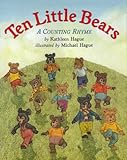
This book’s main use in the classroom would be to practice counting numbers and practice or introduce rhyme. It starts out with 10 little bears, and has a 4-line rhyme represented by 10 bears around the words and a matching illustration on the next page. Then it continues that same format throughout the entire book, each time counting down one bear. I think this would be a great book for beginning readers for many reasons.

First of all, it has very large font, and the pictures are correlated to the words directly. If the words are about bears skating, the picture will be about bears skating. This is a great way for kids to learn to use illustrations to help them figure out words, and then match the word “skate” which they see on the page to the mental image of the illustration of “bears skating”.

The story is written in rhyme, and it is rhyme that is quite easy to hear. So, this would be a good book to read aloud and let the students guess what word comes next after you read the first part of the rhyme. It would also be a good way to pull out those words and create a word matching activity or something of that sort.

Because this is a counting book, there is a pattern that the entire book follows, so it is great for beginning readers, because it will be easy for them to follow along. They are also likely to recognize the number words such as “one, two, three etc…” so reading this book will help them build confidence. Lastly, the book would be easy to use as an example if you wanted your class to create a counting book or to practice rhyming words or something. It is a pretty simple book, but I think there is a lot young readers could get out of it.

My Many Colored Days


My Many Colored Days
By Dr. Seuss
Paintings by Steve Johnson and Lou Fancher
4/5 ****
Kindergarten-1st graders

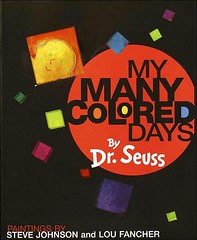
This is not a typical Dr. Seuss book, the rhyme scheme is there but it is not obvious or exaggerated.  And the story does not take place in a fantasy world, but it is not necessarily realistic either.  The story is simply a boy who tells about what he feels like on different days, represented by colors.  He talks about his blue days, his yellow days, his hot pink days and his black days.  The illustrations are beautiful, colorful, very lively and abstract looking.

I find it interesting that he chose to represent the different feelings with colors, and I think this is such a great way to relate to kids and how they think.  By using colors instead of big words and complicated emotions, kids can understand what the little boy is feeling.  It could be a way to start introducing the idea of “connotations” to a slightly older group of students, for example: what do you think the boy is feeling when he is blue? What makes you think that? What kinds of feelings does the color black make you think of, happy ones or sad ones? And other questions like this to help students start to get the idea that authors use certain types of words, or in this case colors, to make the reader feel a certain way.

Another great reason to use this book is to help younger kids understand moods and feelings on a different level.  This book says that it is okay to be mad, sad, happy, excited, gloomy etc… at different times. It is even okay to feel confused about how you feel at certain times.  I think that younger kids can be confused by their feelings, and this helps reinforce the idea that it is okay experience different feelings and that everyone goes through different emotions.  I think this theme is an important one to discuss, and could be easily related to a writing exercise or to another topic in a different subject.  

The King who Tried to Fry an Egg on His Head


The King who Tried to Fry an Egg on His Head
By Mirra Ginsburg
Illustrated by Will Hillenbrand
(Based on a Russian tale)
4/5 ****
3rd-5th graders

I thought this was a very interesting story.  It is about a poor King and Queen and their three daughters, who eventually marry the sun, moon and black raven.  The King visits each of his happily married daughters, and learns something from each of them, but fails to replicate the task. 

One literary element that really stood out to me was personification.  The sun, moon and raven (all non-humans) married the three beautiful young princesses.  They were then later referred to as the King’s “sons-in-law” which is an interesting concept in itself.  Although the sun, moon and raven all married the princesses, they remained their non-human selves, yet they had faces and seemed to act in a human way. This would be a great way to introduce a new type of writing to younger students, who may or may not be aware of having non-human characters in their writing.  It could also be a way to introduce the idea of metaphors, on the very basic level of having an object represent a concept or idea.  

Something else that really stood out to me with this book was the thematic content.  There are a couple themes that I think would be great to incorporate into the classroom.  For one thing, the issue of poverty and the idea that people can still thrive even though they may not be rich or own lots of material goods.  (In this book, the King and his family are very poor).  Another great theme is that each individual has special talents, and those talents should be valued by others.  In addition, each individual should be proud of his or her own talents. In the book, the sun can make the most delicious omelet, the moon can create light in the darkness and the raven can keep people warm on cold nights.  The King tries to replicate these talents, and he fails.  The book ends with the quote “And they lived peacefully and by their own wits forever after”.  They realize they have their own talents and it is un-necessary to try to imitate others.