Tuesday, November 16, 2010

The Misfits


The Misfits
By James Howe
5/5 *****
5th-7th Graders

            The Misfits is the story of 5 young students who are all outcasts in their school, and their struggles to fit in or find their niche.  They form a political party to run for student council, in order to force their peers to accept diversity and each other’s differences, but they are denied by their teachers.  Instead, they end up running as a No-Name Party based on the platform that nobody should ever be called names, because it is very hurtful. 
            Addie, Skeezie, Bobby and Joe struggle are called so many names by their peers; nerdy, geeky, greasy and many derogatory names referring to Joe’s sexual identity.  While reading this book, I was quite appalled; I did not have this experience growing up, nor do I remember seeing it happen, although I am quite certain that it probably did happen to some of my peers.  I want to give the other students the benefit of the doubt, and to argue that maybe they didn’t realize how hurtful they were being.  I think this is a really great book for upper elementary students and even middle school students to read, because the characters are so easy to relate to; not everyone can see themselves as Addie, Skeezie, Bobby or Joe, but we probably have seen an Addie, Skeezie, Bobby or Joe at some point in our lives.  And whether or not we will admit it, many of us have at least felt uncomfortable or left out or felt different at some point in time.
            I’m sure that this novel is considered controversial, just because of all the touchy issues it addresses (mostly the homosexuality, but also bullying, emotional abuse, diversity, racism, discrimination, lack of teacher/adult support etc…), but given the chance I think I would definitely teach this novel. This book may make students feel uncomfortable, but in my mind, if they are feeling uncomfortable about it then they are really getting the point of it; they see how hurtful it is, and maybe they are relating to it and that is making them reflect on the novel.  I don’t think that any student will be personally offended by this novel, which makes me feel that it is a book that students can learn from, and they may not be able to learn about these issues to this extent in another book, so that justifies teaching it in the classroom.
One theme that is so important and so apparent in this novel is that: “Different is okay, and we should accept people for who they are”.  I think that especially considering the target audience of this novel, reinforcing that idea is so crucial.  Given what has been happening lately in our society, bullying is such a problem, and the way to prevent it in the future is to teach our children and students just how hurtful it can be.  

Tuesday, November 9, 2010

The Woodson Experience

        After reading some of Woodson's books, both novels and picture books, I think she is one of the most thought-provoking and talented authors I have read.  She has a way of addressing such tough issues and controversial topics, yet she doesn't lose quality of writing or literary elements.  I think a couple major literary elements she uses especially effectively are metaphor and symbolism.  Because she is often addressing such tough topics, I think these are great to take advantage of.
        I found myself really connecting to her characters and becoming emotionally invested both in her novels and picture books.  I think it takes such a special author to create these feelings for the reader, and it makes her message so much more powerful and meaningful.
       I really want to commend Woodson for writing about topics many authors scare away from (homosexuality, poverty, segregation, racism, family, religion, bullying, friendship and disabilities/difference among MANY other), and as a future teacher, I definitely want to incorporate her and her books into my classroom.  I think is is so important for us as educators to incorporate discussions on these topics in the classroom, especially before students come across them in real life.  So many of these topics are still causing so many problems in our society today, and in order to change things for the future, we need to start with teaching acceptance and equality to our children and students.
          I can honestly say that, although I have only just learned of Woodson in this class, I think that she is such an admirable person and author, potentially one of my new favorites, and I know I will incorporate some of her books into my classroom, and hopefully get the chance to teach some of her novels.

The Other Side


The Other Side
By Jacqueline Woodson
Illustrated by E.B. Lewis
5/5 *****
Grades 1-4

            After reading this book, I instantly ordered in online for my future classroom.  It is an amazing book that has so many great uses for the classroom.  Woodson is such a talented author, especially because she can write and reach so many different audiences.  This story takes place in a small town that is racially segregated.  The two main characters are Clover (a young black girl) and Annie (a young white girl) who are neighbors, and a fence separates their yards.  Annie is very lonely, while Clover is always playing with friends in her yard.  Clover and Annie have each been told not to cross over the fence by their mothers, and abide by this rule; they have never spoken to each other.  Finally, one day they meet and become friends.  They begin to play together, and sit on the fence talking.
            The most incredible part about this book, is Clover and Annie’s conversation on the final page of the book, “Someday somebody’s going to come along and knock this old fence down,” Annie said.  And I nodded, “Yeah,” I said, “Someday”.  This has such a strong and intense underlying message, and I think it is one that students will really understand and relate to. 

Woodson to carefully creates a relatable, believable, touching story of friendship while addressing such intense and emotional underlying issues as well; I think she does such an amazing job of this.  This would be a great way to introduce a discussion on racism, segregation, friendship and many other topics. I think this would be a great way to incorporate literary elements into the classroom as well; the fence is such a strong metaphor and symbol in the book, as are Clover and Annie. 
This would be a great book to use as a cross-curricular resource as well as just a very touching and interesting story that I think kids would really enjoy, relate to, and comprehend on a very deep level.  

A Safe Home for Manatees

A Safe Home for Manatees
By Priscilla Belz Jenkins
Illustrated by Martin Classen
5/5 *****
Grades 2-4

         I thought Jenkins did a great job of incorporating several different writing styles and aspects of Manatee life into this book. She included factual information about Manatee’s: how they live, what they eat, what their relationship with their babies is and much more. In addition, she weaved in a personal story of a mother and baby manatee and how they fight to survive despite many human-caused complications. Because of the diversity she uses, this book could be used in so many different ways.
        One of the first ways I noticed would be to use it to introduce the Manatee or a unit on marine life, habitats, life cycle, the ocean or many other great topics. Using the Manatee to introduce a broad unit would be very beneficial, because most students wouldn’t have very much, if any, background knowledge on Manatee’s, so this would likely be an intriguing book for them. At the end of the book there is a page giving more information on how to help save the Manatee’s, which are a recently endangered species. This is a very empowering section, as kids could write a letter to someone or simply spread the word about Manatee’s and their struggles and feel like they are helping to solve a major, worldwide problem.
          Another great way to use this book in the classroom, is to introduce a science lesson on the environment. The book gives several specific examples of how human pollution causes major problems in the lives of the mother and baby Manatees. Giving students examples of how the human race doesn’t always respect nature and when we litter or as a society put our waste into other animal’s homes, their lives become very difficult. How would we feel if animals were putting trash in our homes or schools? I think this book has such great examples of the negative impact we as humans have on animals. Then at the end of the book, the Manatee’s finally reach a “Manatee-safe area” which humans created. This could open the door for many different animal rights or environmentally friendly groups to be discussed or simply introduced.
         I think that this book is foreshadowing events in our future as a society. It doesn’t tell the reader what is going to happen in the future, but if we keep disrespecting animals and our environment, they will soon have no place to go. And there is something that we can do to prevent this, which I am very glad the author included at the end of the book, because it makes it so much more meaningful to the students reading it to know they can make a difference. I would definitely use this book in my classroom; I think that it is a very interesting and intriguing topic with lots of lessons to teach students.

The Promise Quilt


The Promise Quilt
By Candice F. Ransom
Illustrations by Ellen Beier
5/5 *****
Grades 2-4

            I loved this book; it was extremely emotional, but I think it has a lot of uses in the classroom and would be very beneficial for students to read.  It is about a family during the Civil War, and the father goes off to fight in the war, and is told from the perspective of his daughter, Addie.  Halfway through the book, Addie finds out that her dad was killed in the war, and they receive his jacket from the army.  Addie wants to make her father proud and fulfill his promise to her she would go to school and get a great education.  In order to do this, she has to give up her dad’s jacket to help her mom make a quilt to sell so they can buy books for school. 
            One thing I really liked in this book was how the illustrations capture the emotions of the characters.  And not only that, but because of the way Ransom writes from Addie’s point of view (a child), we can really feel what she is feeling. Both of these contribute to the emotions the reader goes through throughout the book. 
            I think this would be a good book to use when introducing a Civil War or any type of War unit in social studies.  At the end, there is an overview of the actual history of the Civil War, if students are intrigued and want to read more right away.  This book really gives a different and important perspective that is often forgotten; the families and dreams of children are not often the focus of books written about wartime.  I think that even though kids haven’t gone through this specific situation, it is a good way to help reach out to children who have had a loved one, maybe even a parent, die and reinforcing that feeling these emotions after experiencing something like this is normal and expected.  What is important is to hold on to the positive memories you have of that person, and to do what you think they would be proud of.  By reading this book, you can discuss those ideas in terms of the book without singling out specific students or situations but still reaching them.

            This can also be used in a language arts or literacy situation.  Addie’s goes through all of this trouble and gives up her most prized possession in order to get an education and to learn how to read and write.  Today, we take school and reading so fore-granted, it could be interesting what kids have to say about what life might be like if they didn’t have the opportunity to go to school. Would they give up everything they had, like Addie, to get an education?
            The red coat is really symbolic in this book, and would be a good way to introduce symbolism or motifs to younger students.  Lastly, there are lots of important messages and themes of this book; importance of family, staying positive in difficult times, value of education and always maintaining hope for the future among others. 

She Is Born

She is Born
By Virginia Kroll
Illustrated by John Rowe
5/5 *****
K-2

            This was a very interesting book, and wasn’t quite what I expected it to be. It is a melting pot book, incorporating many different cultures and showing major similarities in lots of areas; medical personnel, type of clothing/blankets, celebrations/decorations, baptisms, religion, good luck charms, names, eye color, houses, food, crafts, sports, school/education among others. It starts with a picture of a baby girl, and has a different girl growing up eventually into a mother herself; each picture is a woman of a different race or ethnicity and there are several examples of the topics previously listed on each page. So, although different people of different cultures have different types of clothes, food, eye colors etc… we are all either a daughter, sister, cousin, niece, aunt, friend, wife or mother; we are essentially all the same, despite our obvious cultural differences.
        
            I think this book has lots of potential for introducing different social studies units, whether they are studying a new culture, a new religion, or any of the topics mentioned in this book, I think it would be a great way to spark interest in students and intrigue them in many ways. Because it is showing the life of an individual from birth to adulthood, it could be an introduction to a unit on the life cycle. It is also solely based on females, and could be related to feminism.
          
          One literary element I really liked in this book, was that there was a phrase on the first page of the book, “And earth will never be the same,” that was also found on the last page of the book. Not only does it help the book come to a close and tie everything together, it leaves the reader really thinking. Each and every individual changes the word and the earth and many other lives. I think this is an incredibly empowering idea that we should be teaching all students, because this is how we will help individuals continue to grow and develop, even as a global society.

Work

Work
By Ann Morris
4/5 ***
K-1

            I thought this book was a very good example of a melting pot situation. The book doesn’t have a specific plotline, but is a collection of photographs of people around the world doing different types of work. It shows different looking “mommies” working and different “daddies” working different types of jobs, and the message of the book is that we are all people who work hard to achieve our goals in life.

           This book has very few words, and I think the main focus and main value are the photographs. I think it is a good book for beginning or struggling readers, because it still has a complex meaning even though there are so few words. It would be a great way to introduce a social studies unit on different cultures or communities and different jobs people do. Everyone has a role in our society, and we are all working together towards our individual and societal goals.


               In the back of the book, there are detailed descriptions of the situations going on in each picture. There is information on what the person is doing and where the photograph was taken. I think this gives the book more credibility, especially in the eyes of the students, to
know that these are real people who are actually doing this type of work in the world right now. It also is a tool to help students who want to further their knowledge on a certain type of work or about a certain geographic area; this is a great way to spark interest or to be a gateway to a research project of some sort. So, despite the few words, I think there are some great ways to incorporate this book into the classroom.

Tuesday, October 26, 2010

Feathers


Feathers
By Jacqueline Woodson
5/5 *****
6th grade and up

This book was such a quick read, and involved so many different discussion topics and controversies.  Frannie, the main character, is such a passionate and relatable character, she is sure to draw readers into her story.  Frannie lives in a segregated town, although the story takes place in the 1970s.  A new (white) student comes to her all-black school in 6th grade, and the book is about how he adjusts and how Frannie befriends him and many other issues arise. 

This book could be used to relate or introduce many topics, including but not limited to: segregation, racism, religion (Christianity), bullying, adoption, accepting each other’s differences, poverty, disabilities and many others.   The new student is called Jesus, because he is skinny, white and has long, curly brown hair.  Throughout the story, there are numerous references to Christianity, and I think that is one of the main reasons why this book could be slightly controversial for an elementary classroom.  Another reason, is the blatant racism, references to poverty and bullying/stereotyping situations that occur throughout the story.  Frannie’s older brother is deaf and communicates via sign language; Frannie’s mother has gone through multiple miscarriages/infant deaths.  Both of these introduce new issues that students might ask questions about, and could possibly be controversial or uncomfortable to discuss.
 
However, because the book has such a caring and passionate main character, an emphasis on positive family and friend relationships, and a goal to find hope and faith in life, I think that overall the positive things students can get out of this book are definitely worth discussing the possibly controversial topics the book introduces.  If I had the chance to teach this book to upper elementary students I definitely would, although I would make sure to thoroughly discuss all of the topics and make sure the students all feel comfortable about what the book is saying.

One thing that would definitely be worth discussing in terms of literary devices, besides the themes discussed previously, is the metaphor mentioned in the title.  In the beginning of the book, Frannie reads, “Hope is the thing with feathers” and continues to search for this elusive “hope” throughout the book.  She takes it literally at first, but her brother explains to her that it is a metaphor.  This would be a great example that upper elementary students would likely understand, to introduce metaphors and then move into other a discussion of other related literary devices.  

The Giver

The Giver
By Lois Lowery
5/5 *****
5th-6th graders

I absolutely love The Giver. It has always been one of my all-time favorite books, and it was so interesting to re-read it after reading it in either 5th or 6th grade. I read it just for fun in elementary school, and after reading it now, I see that I did not understand lots it the first time. It is such a great example of science fiction and would be such an interesting book to teach in a classroom; if I ever have the opportunity to teach it, I definitely will despite the controversy it explores.

After reading it this time, I had such a different response to it. I still found it incredibly interesting, but I hadn’t previously realized exactly what being “released” meant, the idea that maybe Jonas dies at the end or the extremely controversial society. While this book would bring up so many controversial topic, such as suicide, pre-determined lives, extreme micro-management by a select group of individuals, lying, death, the power of choice, history etc… it would be so beneficial to young students to be exposed to this alternate way of life. I think it would make students really appreciate having the power to choose their own destinies.

This would be a great book to relate to social studies, I think, because of the different historical societies you could relate it to. I know as a young student, I read about our culture here in the United States (pulling teeth, having surgery, riding bicycles etc…) from an outside perspective and I remember thinking it was so strange- not making the connection that it was a description of my own culture and my way of life. I think that it would really help students see other ways of life and other cultures in a more meaningful way, and in a more accepting way. And building this cultural competency is very important in today’s society. There are just so many different directions you could go with this book, the list of topics that come to mind seems almost endless.

And I have to give my opinion on the ending: I personally think that Jonas and Gabe don’t die, that they eventually find Elsewhere and that it is a fulfilling world full of choice and happiness, that is just the optimist in me. I have read the sequel to the book, and while it has nothing to do with Jonas or any of the original characters, I highly recommend it!

The Man Who Walked Between the Towers


The Man Who Walked Between the Towers
By Mordicai Gerstein
5/5 *****
3rd-5th graders

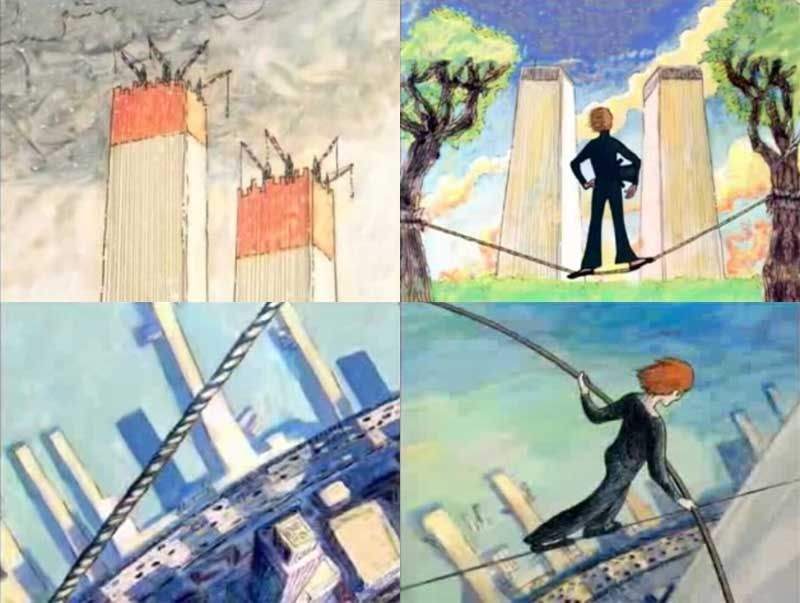
I found this Caldecott Award winning book to be quite unique and interesting. It wasn’t the typical non-fiction story.  The illustrations were outstanding; several of the pages opened up into 3-page long illustrations detailing city skylines and beautiful views of the city. Philippe, the main character in the book, secretly ties a wire between the World Trade Centers, and walks across it mid-day in 1974.  It is based on true events according to the final page of the book.   I think this would be a great book to use in the classroom for several reasons.

The illustrations are fantastic.  They expand on what the writing says, and this is one sign of a high quality picture book.  One main way I would personally use it in the classroom, is to relate to social studies.  This is based on a historical event, although it may not follow the exact details all the way through.  It would be great to have upper elementary students do some research on a little known figure in history, and to think of some way to creatively tell their story to the class.  It would be a fun and interesting way to explore different parts of history, and then to use creativity and writing skills to share their findings with their peers.  Because the police were involved and Philippe was arrested for his actions, this is yet another way to relate the book to history.  There have been many times that people in history have done things knowing they would get arrested, but they did them anyway because they felt passionately about it.  Using this as a light hearted example to lead into Civil Rights era situations (ie Rosa Parks, Ruby Bridges, peaceful sit-ins etc… ) could be a meaningful activity for the students.
The language the author used to write this story is absolutely beautiful.  It is almost poetic sounding, although there is no rhyming involved.  The descriptions of events and people are very detailed, and it really gets the reader intrigued and curious about what is going to happen.

One thing that was a little awkward for me was when the author mentioned, “Now the towers are gone”.  I felt like it either needed to be left out or at least briefly explained.  Because 9/11 is such a tragic and recent event in our history, it is almost insulting to those who have been directly impacted by the attacks of 9/11 to mention it so briefly like this.  

Frederick


Frederick
By Leo Lionni
5/5 *****
3rd-4th Graders

Leo Lionni was one of my favorite authors as a child.  He is a very talented illustrator, which makes his stories all the more interesting to read.  This particular book is about a field mouse named Frederick, who instead of doing physical labor and preparing for the winter, takes in each beautiful moment and ray of sunshine to save for the wintertime.  The other field mice think he is crazy to not be collecting food and preparing for the cold winter.  When winter comes, and the field mice run out of food and start to lose morale, Frederick tells them stories and shares his memories of beautiful spring colors and of warm rays of sunshine.  This helps them get through the rough winter, and they praise his special poetic abilities. 

One thing that this story does effectively is repetitive phrasing.  It never repeats exact phrases, but it uses several examples of stating what most of the field mice are doing, then they ask Frederick why he isn’t doing what they are, then Frederick responds by saying why he is doing what he is doing.  This common pattern will help students comprehend better and follow the plotline more effectively.  It also would be a good way to incorporate predictions. 

The theme of the story is a happy one; we should all honor each other’s different talents.  The field mice question Frederick, but then they later realize that he is different, and that is okay; they are impressed by his difference talents and embrace him as a fellow field mouse.  Each different personality has a nitch, and although Frederick’s nitch was not initially recognized, it eventually proved to be necessary to the survival of all the mice. 

This could be tied into social studies and learning about different roles in society, it could be tied into accepting everyone for who they are even if they are different, and many more similar topics.  

Ten Little Bears: A Counting Rhyme

Ten Little Bears: A Counting Rhyme
By Kathleen Hague
Illustrated by Michael Hague
4/5 ****
Kindergarten-1st graders

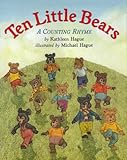
This book’s main use in the classroom would be to practice counting numbers and practice or introduce rhyme. It starts out with 10 little bears, and has a 4-line rhyme represented by 10 bears around the words and a matching illustration on the next page. Then it continues that same format throughout the entire book, each time counting down one bear. I think this would be a great book for beginning readers for many reasons.

First of all, it has very large font, and the pictures are correlated to the words directly. If the words are about bears skating, the picture will be about bears skating. This is a great way for kids to learn to use illustrations to help them figure out words, and then match the word “skate” which they see on the page to the mental image of the illustration of “bears skating”.

The story is written in rhyme, and it is rhyme that is quite easy to hear. So, this would be a good book to read aloud and let the students guess what word comes next after you read the first part of the rhyme. It would also be a good way to pull out those words and create a word matching activity or something of that sort.

Because this is a counting book, there is a pattern that the entire book follows, so it is great for beginning readers, because it will be easy for them to follow along. They are also likely to recognize the number words such as “one, two, three etc…” so reading this book will help them build confidence. Lastly, the book would be easy to use as an example if you wanted your class to create a counting book or to practice rhyming words or something. It is a pretty simple book, but I think there is a lot young readers could get out of it.

My Many Colored Days


My Many Colored Days
By Dr. Seuss
Paintings by Steve Johnson and Lou Fancher
4/5 ****
Kindergarten-1st graders

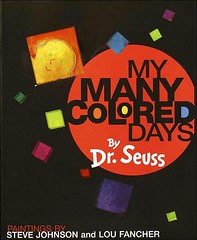
This is not a typical Dr. Seuss book, the rhyme scheme is there but it is not obvious or exaggerated.  And the story does not take place in a fantasy world, but it is not necessarily realistic either.  The story is simply a boy who tells about what he feels like on different days, represented by colors.  He talks about his blue days, his yellow days, his hot pink days and his black days.  The illustrations are beautiful, colorful, very lively and abstract looking.

I find it interesting that he chose to represent the different feelings with colors, and I think this is such a great way to relate to kids and how they think.  By using colors instead of big words and complicated emotions, kids can understand what the little boy is feeling.  It could be a way to start introducing the idea of “connotations” to a slightly older group of students, for example: what do you think the boy is feeling when he is blue? What makes you think that? What kinds of feelings does the color black make you think of, happy ones or sad ones? And other questions like this to help students start to get the idea that authors use certain types of words, or in this case colors, to make the reader feel a certain way.

Another great reason to use this book is to help younger kids understand moods and feelings on a different level.  This book says that it is okay to be mad, sad, happy, excited, gloomy etc… at different times. It is even okay to feel confused about how you feel at certain times.  I think that younger kids can be confused by their feelings, and this helps reinforce the idea that it is okay experience different feelings and that everyone goes through different emotions.  I think this theme is an important one to discuss, and could be easily related to a writing exercise or to another topic in a different subject.  

The King who Tried to Fry an Egg on His Head


The King who Tried to Fry an Egg on His Head
By Mirra Ginsburg
Illustrated by Will Hillenbrand
(Based on a Russian tale)
4/5 ****
3rd-5th graders

I thought this was a very interesting story.  It is about a poor King and Queen and their three daughters, who eventually marry the sun, moon and black raven.  The King visits each of his happily married daughters, and learns something from each of them, but fails to replicate the task. 

One literary element that really stood out to me was personification.  The sun, moon and raven (all non-humans) married the three beautiful young princesses.  They were then later referred to as the King’s “sons-in-law” which is an interesting concept in itself.  Although the sun, moon and raven all married the princesses, they remained their non-human selves, yet they had faces and seemed to act in a human way. This would be a great way to introduce a new type of writing to younger students, who may or may not be aware of having non-human characters in their writing.  It could also be a way to introduce the idea of metaphors, on the very basic level of having an object represent a concept or idea.  

Something else that really stood out to me with this book was the thematic content.  There are a couple themes that I think would be great to incorporate into the classroom.  For one thing, the issue of poverty and the idea that people can still thrive even though they may not be rich or own lots of material goods.  (In this book, the King and his family are very poor).  Another great theme is that each individual has special talents, and those talents should be valued by others.  In addition, each individual should be proud of his or her own talents. In the book, the sun can make the most delicious omelet, the moon can create light in the darkness and the raven can keep people warm on cold nights.  The King tries to replicate these talents, and he fails.  The book ends with the quote “And they lived peacefully and by their own wits forever after”.  They realize they have their own talents and it is un-necessary to try to imitate others.  

Tuesday, October 12, 2010

Mirette on the High Wire


Mirette on the High Wire
By Emily Arnold McCully
2nd-4th Graders
5/5 *****

Mirette on the High Wire is a great book, I remember reading this as a child, so when I saw it at the library I immediately grabbed it.  It is a Caldecott Award winner, so the pictures are phenomenal.  The pictures are realistic paintings, and have a very unique look to them. 

This was a really inspiring tale of a young girl who helps a master of the High Wire overcome his fears.   One thing I absolutely love, is McCully’s descriptive language.  She uses such creative and descriptive phrases; one of my favorites was this one: “Her feet tingled, as if they wanted to jump up on the wire beside Bellini”.  This is also personification of her feet.  In one of my other classes, we learned about an activity called “Writing through a Mask,” which involves selecting a non-human object and writing through its perspective.  This phrase is a great example of that, and could be pulled out of the story and used to help show the students how this style can be very effective.  Doing a mini-lesson or writing prompt using this phrase would be a great idea to encourage creative and descriptive writing.

Because this book takes place in France, the names of characters are pretty obviously French.  This could be a great way to introduce a social studies, history, art or geography lesson in the classroom.  As a non-French person, French really sounds poetic and beautiful to me, and so when I am reading and hearing these French names, it makes the story feel beautiful and poetic as well.

Another thing I really loved about this book is that in the end it is the little girl who helps the adult overcome his fears.  This is unusual, and such a great reminder to kids that they can make a difference and help other people too.  It shows kids that trying something new and scary (at first) can have great benefits, and we should all go after our dreams. This could also translate into a mini-lesson about kids’ dreams for their futures etc…

The Best of Both Nests


The Best of Both Nests
By Jane Clarke
Illustrated by Anne Kennedy
K-3rd graders
4/5 ****

This is the story of a bird whose parents get divorced, and how he deals with having parents in two different nests.  On another level, it is about creating meaningful friendships and accepting each others’ differences. 

While this book isn’t called “Divorce” it is pretty clearly a metaphor for divorce in our society today.  The parent birds are “Clattering too much, and just aren’t singing the same song anymore”.  The story explores lots of aspects of divorce, and different feelings that kids often have when their parents get divorced.  So, on that level, it would be a good book to read when trying to reach out to those kids who may be going through a divorce at home.  It is a safe way to introduce the idea of divorce, and it encourages kids to help each other deal with those things as well as to accept everyone and all different kinds of families.

I think using this book to talk about the purpose of writing and writing towards a specific audience could be interesting.  Because the purpose of this book and the intended audience are pretty clear, this would be a good book to use to introduce discussion on those topics, probably for older students.  Just getting kids thinking about the purpose of writing and of reading books, as well as writing for different audiences is a great way to get kids thinking about both reading and writing and why it is important. 

Time of Wonder


Time of Wonder
By Robert McCloskey
3rd Graders
3/5 ***

This book is a Caldecott Winner, and so the pictures are what stood out to me the most after reading it.  The beautiful scenery pictures and landscapes are amazing.  As far as the story itself, it got a little bit long for me.  I think most students would lose interest part way through, so unless you read it in parts, I don’t think students would get as much out of it as possible. 

At the end of the book, you find out that the story was about the family’s summer vacation.  This could be a good book to use at the beginning of the school year to encourage students to write about their summer adventures and activities. 

One thing that was great in this book is the descriptive language. It has beautiful pictures, but the words themselves can paint the image in the reader’s head.  McCloskey does a great job of creating images and scenes; it almost feels poetic at points. I think this would be an effective book to use when teaching about descriptive language or how pictures can really add to the story; pulling out certain phrases to use as examples would be great for the kids to see.  But if you’re looking to read it aloud to a group of students, this is not the book I would advise you to choose.  

Controversial Literature

Heather has Two Mommies
By Leslea Newman
Illustrated by Diana Souza
K-3rd Graders
5/5 *****

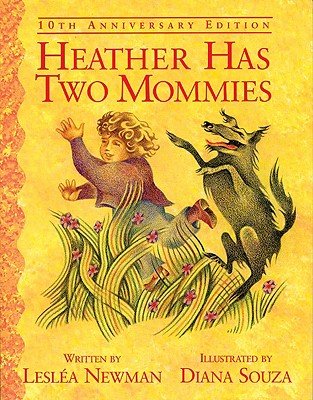
I thought that this was a very interesting book.  It is clearly a controversial book, but I think when used appropriately could be very beneficial in the classroom.  Using this book to help encourage kids to accept each other and each other’s families and to be proud of uniqueness or differences are some of the first things that come to my mind. 

This was not a complex book; I think Newman did a great job of really getting to the point.  I liked how she really got the little girl’s emotions across; it takes a special kind of writer to be able to do that.  In one of the classrooms I volunteer in, they study several different units and “Family” is one.  I think this would be a good book to include, because it not only talks about families with 2 mommies, but it talks about so many different kinds of families.  I think it could reach a variety of students, and that is ultimately what is most important.

I’m sure that many parents would have a problem with this book, although because of the way it is written, I highly doubt that any school aged child would feel uncomfortable while reading or listening to it.  I think that because it teaches such a valuable lesson, a teacher could argue that it is necessary to read to children in order to encourage acceptance of everyone and to show diversity. 

Mommy Laid and Egg
By Babette Cole
3rd-4th Graders
3/5 ***

This book was slightly appalling.  Clearly a controversial book, this book gives slang terms for breasts, explicitly talks about sex and shows lots of different graphics of people having sex.  While I think it is very important for kids to know about sex and how men and women are different, I don’t think this book did the best job of it.  While it is a humorous book, I’m not sure that when first introducing sex education that humor is the way to go.  While I don’t think this book should be banned or anything, because it is not offensive to specific groups of people, I think it would make some young kids a little bit uncomfortable to read. And I’m sure that parents probably wouldn’t be thrilled to have their kids read it at school then come home with lots of questions. I think parents (and teachers) should have a chance to talk about sex before kids just go to the library and check out this book.
 
I don’t think that a teacher could defend this book to a parent, because there are so many other sex education books that would probably be a better choice. This book starts out saying that Mommy laid an egg, instead of going straight to the truth; this could confuse kids.  There isn’t really a major plotline, theme, or many literary devices in the book, so I don’t think that would help defend the book.  While I personally thought it was funny to read as a 20-year-old, I don’t necessarily think it is the best choice for young elementary students. 

The Higher Power of Lucky

The Higher Power of Lucky
By Susan Patron
4/5 ****

So much of what we discussed in class about The Higher Power of Lucky had to do with the literary devices used by Patron.  I think she so skillfully was descriptive when introducing characters and setting; this was one of the things I liked the most. She really painted a picture for me of what was happening, because of the way she described the setting and really everything that happened.  I felt like I could really understand Lucky and get inside of her head, just because of the way Patron wrote.  I really enjoyed the diversity of the characters and their personalities.  I feel like almost everyone could relate to something about at least one of the characters. For me, a book becomes so much more powerful when I can relate on a personal level to someone in the book, and I think Patron did a great job of choosing characters.

One thing that usually is introduced in elementary school, is theme and symbolism.  There are lots of great examples of symbolism in the book, and so many different ways you could go with the theme.  Having so many examples and choices of both symbols and themes makes this book a great book to use to introduce these new ways of analyzing literature; it is likely each student will be able to think of or understand at least one or two of the symbols and themes, so they will have some confidence with identifying them right from the start.

Personally, I think this is a great learning tool, and the controversy over the word "scrotum" is so minor that I almost forgot to mention it in this blog post.  As a teacher, it would be very easy to defend the valuable lessons in this book. The one thing that I struggled with when reading this book, is just how depressing and sad it is.  I feel so bad for Lucky, and she goes through so much for a ten year old.

Fairy Tales

Three Clever Mice
Folktales retold and adapted by Gerda Mantinband
Illustrated by Martine Gourbault
1st -3rd Graders
4/5 ****

I really enjoyed this book; it is not a traditional fairy tale, but it has three fun short tales in it about 3 mice.  Although it does not directly relate to the better-known tale of the 3 blind mice, it could easily be compared and contrasted to that story as well. 

One thing that I thought was very interesting about this book, was the common motif or trend of the number “3”.  There were often 3 tasks, 3 mice, 3 potential mates, 3 sons etc… There were almost always 3 of whatever was going on in each of the stories.  I think this would be a good way to help summarize the book at the end, instead of writing a summary to list all of the sets of 3s students could remember from the book.  Another great literary element was the repetitive phrases.  Especially in the first tale, the main character would repeat the same phrases over and over throughout the book. This is a great and very helpful aspect when working with beginning readers. 

I felt like the stories were very predictable, and they had an almost singsong feel to them.  They were not poetic, but I think because they were so predictable they flowed very well.  The pictures were great; they gave some added details that the text did not necessarily spell out, so that is always a great aspect of picture books for beginning readers.

In addition to these literary elements, I think that the stories teach some great lessons. Although that is not always the first thing to look for when looking for quality literature, I think it is important, and is a great way to generate theme discussions and relate the stories to students’ personal lives.

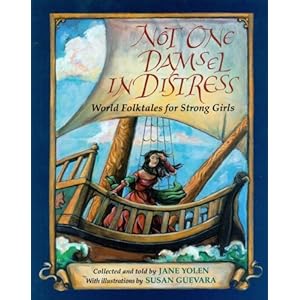
Not one Damsel in Distress: World folktales for Strong Girls
Collected and told by Jane Yolen
Illustrations by Susan Guevara
4th-5th Graders
5/5 *****

This is a collection of short stories, and the stories do not include the typical fairy tale princess who needs a prince to save her.  They are quite the opposite.  There are stories from all different countries from around the world, each with a female heroine.  I really enjoyed this book; as the daughter of a strong feminist mother, I think I am slightly biased towards it.  This is great book that gives a (more admirable) female perspective to the fairy tale world.  

There is a lot of dialogue in many of the stories in this book, so it is a great way to introduce using dialogue in stories students are working on.  It is also a great way to introduce new cultures, different values and other countries in social studies or geography lessons.  Including diversity in the classroom is such an important thing to do these days, and this books gives so many opportunities to do so.

The stories in this book have a common structure.  Instead of having numbered or titled chapters, Yolen uses a different style font for the first few words of a new section, as well as leaving a blank line in between parts.  I think this is important to note, and to show students yet another way of structuring and organizing a story.